
Where McCandless City Directories Are Kept
There is no verified stand-alone, town-wide McCandless directory run in the research. The usable shelf is regional. Pittsburgh and Allegheny volumes can supply leads, but a volume must be checked for its geographic scope before a McCandless household is treated as included. That matters because McCandless remained rural for much of the directory period and grew heavily as a suburb after World War II. A missing name in an urban volume is not proof that the person was absent from McCandless.
| Collection | Years | Where held | Access |
|---|---|---|---|
| Historic Pittsburgh directories | 1815-1945 overall; online Pittsburgh/Allegheny run 1837-1930 with gaps | Historic Pittsburgh contributors | Digitized, with edition-by-edition geography check |
| Carnegie Pittsburgh city directory microfilm, P-202 | Selected 1813-1850; 1856-74; 1876-1932; 1934-62; 1964-65; 1967-75 | Carnegie Library Pennsylvania Department | Counter and microfilm, confirm a North Hills section first |
| Northland Local History | No verified single directory year run | Northland Library and its public local-history site | Maps, clippings, municipal reports, and historical context |
| McCandless/Northern Allegheny Heritage Center | Materials from earlier local history; Center opened 2017 | Town Heritage Center | Yearbooks, family and house-history clues, and community records |
| State Archives Allegheny records | Deeds 1788-1871; grantor/grantee indexes 1788-1904 | Pennsylvania State Archives and many FamilySearch images | Historic name, land, estate, marriage, and death routes |
Use the table as an access map, not as a promise of coverage. Historic Pittsburgh’s online collection guidance identifies J. F. Diffenbacher and R. L. Polk & Company among the publishers and describes gaps in the Pittsburgh and Allegheny run. Carnegie’s later microfilm is the practical next channel when a digitized result stops. The State Archives then provides deed and index material that can anchor an older name to a parcel or estate.
Note: A directory title or city name alone does not establish that a rural McCandless address was included in that edition.
Check McCandless City Directory Geography First
Historic searches use more than one local name. McCandless was formed from Pine Township in 1851, was incorporated and named McCandless in 1857, and became the home-rule Town of McCandless on January 1, 1975. An older catalogue, deed, map, or directory may therefore use McCandless Township, Pine Township, or a nearby postal locality. Search these labels as controlled variants, then compare the result with the parcel’s municipality, lot or block, and the period map.
This check also prevents a common reading error. A Pittsburgh mailing label, or a volume focused on Pittsburgh and Allegheny City, does not by itself place a household inside McCandless Township. The safest match joins the printed geography to a map or deed, then to a year appropriate for the person being researched. Northland’s local maps and the county’s recorded land sources are especially useful when a road or subdivision description is more stable than a postal label.
McCandless City Directory Digital Shelf
The University of Pittsburgh’s Historic Pittsburgh collection is the principal digital city directory route. Its collection description covers 1815-1945 and identifies personal and business name-and-address directory material, with contributions from Pitt Archives & Special Collections, the Heinz History Center’s Detre Library & Archives, Pittsburgh History & Landmarks Foundation, and Carnegie Library of Homestead. Representative items include G. H. Thurston’s 1870/71 directory and R. L. Polk’s five-volume Pittsburgh directories for 1923 and 1926.
Use a confirmed result as a lead, then record the edition title, year, and place named on the scan before connecting it to a McCandless family. A 1900 Pittsburgh, Allegheny City and Allegheny County business directory may be a useful regional lead, while an urban residential volume may omit the township. For a post-1930 need, Carnegie’s P-202 microfilm can extend the search well beyond the online run. Contact its Pennsylvania and Family & Local History Department before visiting to confirm the particular reel and local scope.
- 1815-1945: Historic Pittsburgh’s overall city-directory collection range.
- 1837-1930: The online Pittsburgh and Allegheny run, with stated gaps.
- 1967-1975: The latest stated Carnegie P-202 city-directory microfilm range.
Historic Pittsburgh’s digitized directory collection is shown below with the collection titles and contributors visible in the source.
The digital shelf is best treated as a searchable starting point. Its strongest use is comparing a confirmed name or address with a map, a county deed, or a later household source, rather than assuming a complete municipal list.
Northland’s McCandless Map Trail
Northland Public Library supplies the most local open-web context for city directory work. Its Town of McCandless history material links an 1850 county map, the 1914 Warrantee Atlas plate 35, a McCandless index map, the 1908 Sewickley quadrangle, the October 1947 zoning map, and 1940 G. M. Hopkins plat-map plates 27-30. Those sources can keep a lot, road, or subdivision continuous when an older directory uses a place label that does not match a present-day address.
Northland also keeps local files of clippings, pamphlets, maps, municipal reports, and newsletters. Its local-history website is open, although some electronic resources require a card or library computer. The library is a FamilySearch Affiliate Library, so a visitor with a free FamilySearch account can access additional digital images on site. That is a useful local-history route when a catalogue lead needs a stronger family, parcel, or map connection.
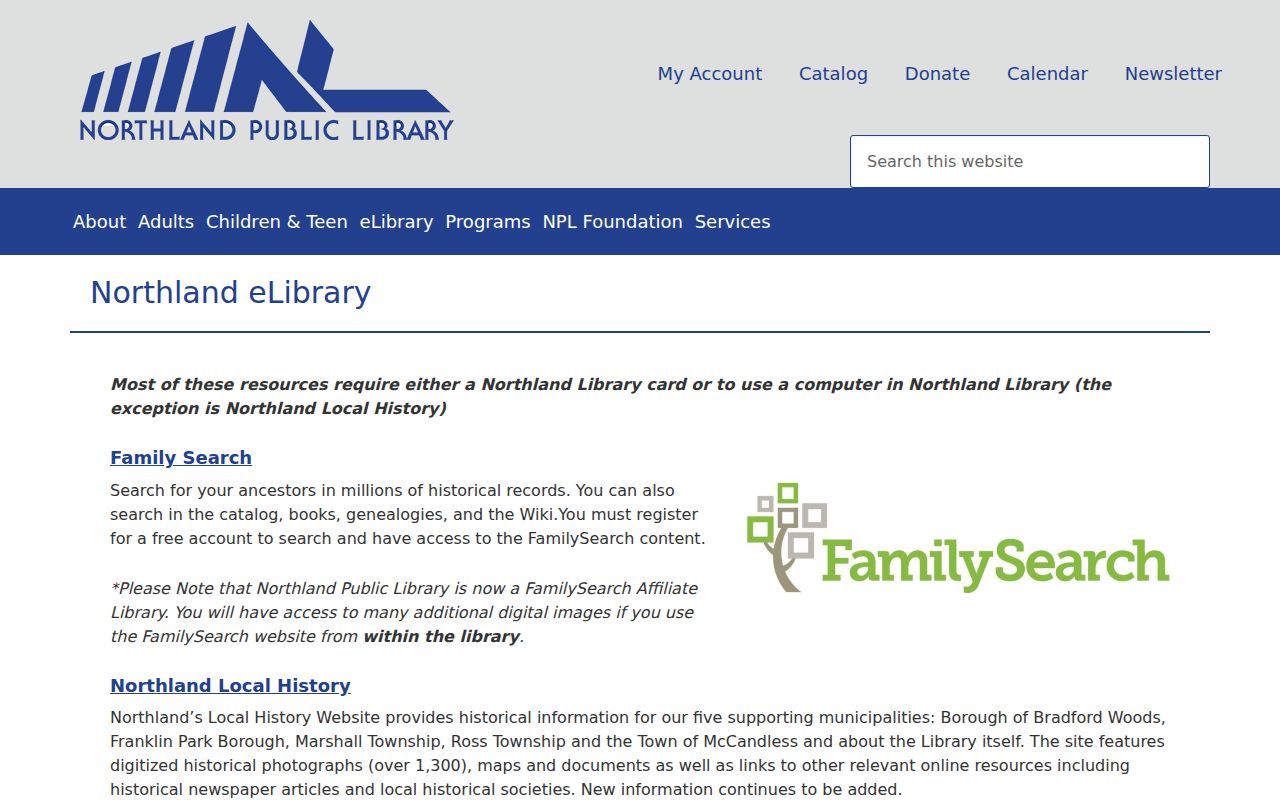
Northland’s eLibrary and local-history access page shows the library route for McCandless Township city directory research.
Northland is at 300 Cumberland Road, Pittsburgh, PA 15237, and lists 412-366-8100 and northland@northlandlibrary.org. Published summer hours are Monday through Thursday 9-8, Friday 9-6, Saturday 9-5, and Sunday closed; confirm seasonal hours before travel.
Note: Additional FamilySearch images are available on site, not as a guarantee that a chosen directory volume contains McCandless.
How McCandless City Directory Entries Read
Historic Pittsburgh’s collection metadata verifies personal and business name-and-address listings, but the research capture did not reach an individual page image or abbreviation-key page. It would be inaccurate to promise that every selected edition gives an occupation, spouse notation, ownership mark, or a McCandless street listing. Read only what the chosen printed entry and its own front matter support. Photograph or save the edition title and abbreviation key with any line used in family research.
| Edition title and year | Confirms which directory is being read and avoids mixing entries from different volumes. |
|---|---|
| Geographic wording | Shows whether the volume identifies Pittsburgh, Allegheny City, a county area, or another place. |
| Name-and-address line | The collection metadata confirms this listing type; verify the actual line on the selected scan. |
| Abbreviation key | Read the key in that volume before interpreting any shorthand or symbol. |
| Page image | Preserves the source context for a later comparison with maps, deeds, census, or obituary evidence. |
- Directory entry
- A printed listing that must be read in its own edition and geographic context.
- Householder evidence
- A dated record that can help identify a household, but does not prove a present residence.
- Abbreviation key
- The volume’s own explanation of its shortened terms or marks; use it before drawing conclusions.
A directory find should be treated as one dated observation. Compare spelling, address wording, and the place label across other records. If the edition does not clearly cover the township, retain it as a regional clue rather than turning it into a claimed McCandless household record.
McCandless City Directory Clues at Heritage
The McCandless/Northern Allegheny Heritage and Cultural Center adds the local materials a regional city directory often lacks. The Town says the collection grew from historian Joseph Bullick’s endangered holdings and opened in 2017. It includes North Allegheny school photographs, documents, yearbooks, and sports items, along with service-group scrapbooks, family histories, photographs, clippings, oil and electric-railroad records, and material on Judge Wilson McCandless.
The Center says its collection is used for family and house-history research. A focused inquiry works best: give a name, approximate years, a school, church, or community organization, and a street or house context when known. The collection is not described as a fully searchable personal-membership roster. It is a way to test a regional directory clue against McCandless community material without claiming that the Center has a file for every family.
The Town’s Heritage Center page introduces the public historical-collections route.
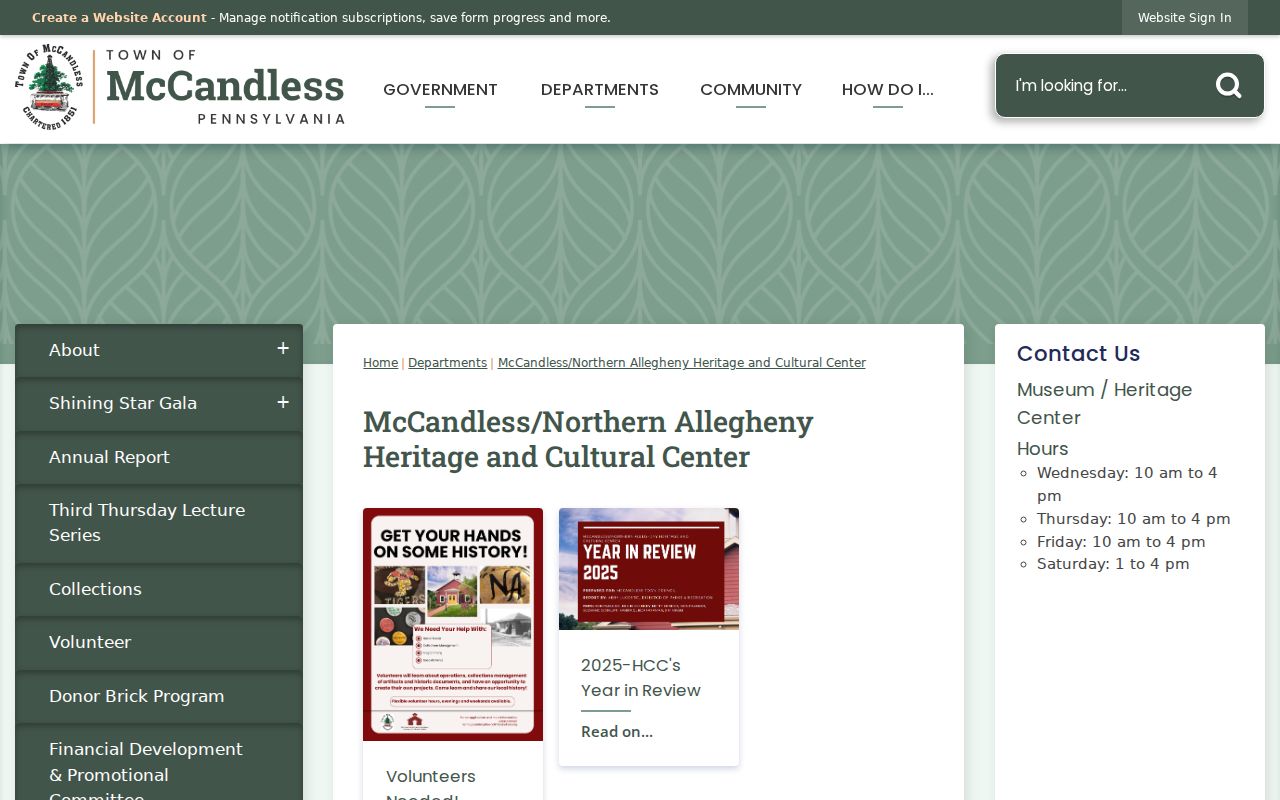
The published visitor hours are Wednesday through Friday 10-4 and Saturday 1-4. Calling ahead with a focused historical question helps staff connect a directory lead to the most relevant map, yearbook, clipping, or family material.
Tracing Families With McCandless City Directories
Use city directories as a sequence of dated leads, not as a complete roll. Begin with the earliest edition that actually covers the needed place, keep the spelling exactly as printed, and compare the result with a parcel, deed, map, or census record from a nearby date. Federal census schedules are released after the federal 72-year rule. That pairing can show whether a directory-era name and a household record are consistent without assuming that either source alone explains every person at an address.
- Choose a volume whose stated geography can plausibly include McCandless Township or the relevant county area.
- Save the title, year, page, name spelling, and address wording from each confirmed entry.
- Compare the address or lot context with a Northland map, Hopkins plate, or county land record.
- Pair the closest directory years with released census material, then note what agrees and what remains uncertain.
- Use a death notice or estate route to test a disappearance from the paper trail instead of assuming a move or death.
Carnegie’s obituary and death-notice request form gives searchable windows of 1786-1913, 1963-1998, and 2001-present, with a stated four-to-six-week turnaround. The State Archives offers another historic bridge through Allegheny deed, grantor/grantee, estate, marriage, death, and will material. A later current-record question belongs with the appropriate custodian, not with an old directory line.
McCandless City Directory Gaps and Fallbacks
A blank search is often a coverage question. The digitized collection has stated gaps, Carnegie’s microfilm is the post-1930 shelf route, and the research did not verify a McCandless-specific criss-cross or reverse directory. Do not claim a street-order directory exists until a library identifies a title and year. For an older address, the verified map sequence is stronger: Historic Pittsburgh’s Hopkins collection spans 1872-1940, with relevant 1906 and 1940 northern-area volumes, while Northland links the 1914 Warrantee atlas and 1947 zoning map.
Heinz History Center’s Recorder of Deeds collection, 1769-1919, has a township series open for research. It is a useful escalation when an online county index has a date or image gap. That layered approach respects the historical record: a directory may provide a lead, but a map, deed, estate, or census record may supply the necessary confirmation.
Note: Never interpret an unverified city directory omission as proof that a McCandless person or address did not exist.